Specifications of Polymer Modified Bitumen PMB 25/55
PMB 25/55 is a hard polymer modified bitumen with a penetration of 25 to 55 (0.1 mm) at 25 °C, placed in Class 3 of EN 14023. It sits between the very stiff PMB 10/40 and the general-purpose PMB 45/80, and is chosen when a road needs more stiffness than a medium grade can give but still needs a binder that works in upper pavement layers. Its typical home is the binder or surface course of a heavily trafficked road in a region with high summer pavement temperatures. PMB 25/55 is part of the Tiger Bitumen Polymer Modified Bitumen range.
Tiger Bitumen is the product brand of HY International Group. Export enquiries for PMB 25/55 are quoted against the complete EN 14023 designation and property classes stated in the buyer’s project specification.
| Property | Requirement for PMB 25/55 | Test method |
| Penetration at 25 °C, 0.1 mm | 25–55 (EN 14023 Class 3) | EN 1426 |
| Softening point (Ring & Ball), °C | Declared minimum; written after the dash in the full designation | EN 1427 |
| Cohesion – force ductility, J/cm² | Declared class; confirmed against the product specification | EN 13589 + EN 13703 |
| Resistance to hardening – change of mass, % | Declared class; confirmed against the product specification | EN 12607-1 |
| Resistance to hardening – retained penetration, % | Declared class; confirmed against the product specification | EN 12607-1 + EN 1426 |
| Resistance to hardening – increase in softening point, °C | Declared class; confirmed against the product specification | EN 12607-1 + EN 1427 |
| Flash point, °C | Declared class; confirmed against the product specification | EN ISO 2592 |
| Fraass breaking point, °C | Declared class; confirmed against the product specification | EN 12593 |
| Elastic recovery at 25 °C, % | Declared class; confirmed against the product specification | EN 13398 |
| Storage stability – difference in softening point, °C | Declared class; confirmed against the product specification | EN 13399 + EN 1427 |
The grade name fixes one property only: penetration. Every other property in EN 14023 is selected from a set of classes, and two PMB 25/55 products can legitimately declare different classes. For that reason the complete EN 14023 designation and each applicable property class must be confirmed against the relevant product specification for every order. If a project specification measures cohesion by tensile test (EN 13587) or Vialit pendulum (EN 13588) rather than force ductility, the specified method applies.
Reading a PMB 25/55 designation
On drawings and tender documents PMB 25/55 normally appears with its softening point suffix. PMB 25/55-60, a designation found in practice, means a penetration of 25 to 55 (0.1 mm) at 25 °C and a softening point of at least 60 °C. Another project may call for a different suffix, so always quote the designation exactly as the specification writes it.
Why engineers specify PMB 25/55
- Rutting resistance in hot weather. A hard base binder reinforced by a polymer network resists wheel-path deformation when pavement temperatures are high.
- Stiffness that still suits upper layers. It is noticeably softer than PMB 10/40, which makes it workable in binder and surface courses rather than only in structural base layers.
- Cohesion under repeated loading. Polymer modification adds cohesion and elastic recovery that a hard straight-run bitumen does not provide, helping the layer resist fatigue.
- Ageing behaviour matters. Hard binders in hot climates age in service, so the declared resistance-to-hardening classes (retained penetration and softening point increase after RTFOT) deserve close attention.
Applications of PMB 25/55
- Binder courses and surface courses on motorways, trunk roads and busy urban arterials.
- Stone mastic asphalt (SMA) on heavily trafficked routes in hot regions.
- Climbing lanes, roundabouts, signalised junctions and bus corridors, where slow heavy vehicles concentrate rutting.
- Airfield pavement layers, where the project specification calls for a hard polymer modified binder.
Selecting PMB 25/55
PMB 25/55 fits projects where heavy traffic and heat are both present. The binder named in the project specification always takes priority; as a general guide:
| If the project needs… | Consider |
| A hard modified binder for surface or binder courses under heavy traffic in a hot climate | PMB 25/55 |
| Maximum stiffness in a structural base or binder layer under standing loads | PMB 10/40 |
| A general-purpose modified binder for surface courses in moderate climates | PMB 45/80 |
| A highly modified binder for thin surfacings or porous asphalt | PMB 40/100 |
| An unmodified hard paving grade | Bitumen 40/50 |
Manufacturing and export considerations
A hard PMB is only as consistent as its manufacture. The base bitumen must be compatible with the polymer, the polymer must be fully dispersed and matured, and the finished binder must stay homogeneous in hot storage. For export orders that travel long distances before use, storage stability is especially important because the binder may be reheated on arrival.
When requesting PMB 25/55 for export, include the destination port, the quantity and the complete designation with any required property classes. HY International Group’s export team confirms these against the relevant product specification before quoting.
Handling PMB 25/55
PMB 25/55 needs higher mixing and compaction temperatures than an unmodified bitumen of similar penetration, because the polymer raises viscosity. Work within the temperature limits stated for the specific product, avoid holding the binder hot for long periods, and avoid repeated reheating cycles. Check the declared elastic recovery and storage stability classes, since together they confirm that the polymer is present and evenly distributed.
PMB 25/55 FAQs
What is PMB 25/55?
PMB 25/55 is a polymer modified bitumen with a penetration of 25 to 55 (0.1 mm) at 25 °C. It is Class 3 in the EN 14023 penetration classes, one step softer than PMB 10/40.
What is the difference between PMB 25/55 and PMB 45/80?
PMB 25/55 is harder and stiffer. It is chosen for heavier traffic and hotter climates, while PMB 45/80 is the more general-purpose grade for surface courses.
When should I use PMB 10/40 instead of PMB 25/55?
Choose PMB 10/40 when maximum stiffness in a structural layer is the priority. PMB 25/55 keeps more workability and is better suited to binder and surface courses.
Is PMB 25/55 suitable for stone mastic asphalt?
Yes. It is used in SMA on heavily trafficked roads, particularly where summer pavement temperatures are high. Follow the binder grade named in your SMA mix specification.
How does PMB 25/55 compare with Bitumen 40/50?
Their penetration ranges overlap, but PMB 25/55 is polymer modified. It has the cohesion and elastic recovery that unmodified Bitumen 40/50 does not have.
Can PMB 25/55 be used where winters are cold?
Only after checking its declared Fraass breaking point class against the lowest expected pavement temperature. Hard binders lose flexibility in the cold, so softer grades are usually preferred for severe winters.
What should I send to request a PMB 25/55 export quotation?
The complete EN 14023 designation with any required property classes, quantity in metric tons, destination port and packing preference.
Request a Tiger Bitumen PMB 25/55 quotation
Send the complete designation (for example PMB 25/55-60), quantity in metric tons, destination port and packing preference. The HY International export team replies with price and lead time.


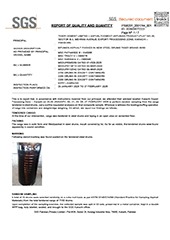
SGS Inspection Report Grade 35/50 Loading the Month of Jan-Feb 2026
Tiger Bitumen Price List
English Version
French Version