Specifications of Polymer Modified Bitumen PMB 65/105
PMB 65/105 is a medium-soft polymer modified bitumen grade with a penetration range of 65 to 105 (0.1 mm) at 25 °C. It is considered for pavement projects where flexibility and resistance to cracking are important design priorities. The required EN 14023 property classes must be confirmed against the complete product designation and project specification.
The softer consistency can be useful in applications where low-temperature flexibility matters, while polymer modification helps improve performance compared with an unmodified binder of similar penetration. The final suitability of PMB 65/105 depends on the pavement design, expected climate, traffic conditions, and specified binder properties. It follows PMB 40/100 and precedes PMB 75/130 in the Tiger Bitumen Polymer Modified Bitumen range.
Tiger Bitumen is the product brand of HY International Group. PMB 65/105 export enquiries are assessed against the complete EN 14023 designation and the property classes specified for the buyer’s project.
Tiger Brand PMB 65/105 Specifications (EN 14023)
| Property | Requirement for PMB 65/105 | Test method |
| Penetration at 25 °C, 0.1 mm | 65–105 (EN 14023 Class 6) | EN 1426 |
| Softening point (Ring & Ball), °C | Declared minimum; completes the full designation | EN 1427 |
| Cohesion – force ductility, J/cm² | Declared class; confirmed against the product specification | EN 13589 + EN 13703 |
| Resistance to hardening – change of mass, % | Declared class; confirmed against the product specification | EN 12607-1 |
| Resistance to hardening – retained penetration, % | Declared class; confirmed against the product specification | EN 12607-1 + EN 1426 |
| Resistance to hardening – increase in softening point, °C | Declared class; confirmed against the product specification | EN 12607-1 + EN 1427 |
| Flash point, °C | Declared class; confirmed against the product specification | EN ISO 2592 |
| Fraass breaking point, °C | Declared class; confirmed against the product specification | EN 12593 |
| Elastic recovery at 25 °C, % | Declared class; confirmed against the product specification | EN 13398 |
| Storage stability – difference in softening point, °C | Declared class; confirmed against the product specification | EN 13399 + EN 1427 |
Only the penetration range is indicated by the PMB 65/105 grade name. The softening point and other performance properties depend on the complete designation and the applicable classes in the product specification. These details should be confirmed before an order is accepted. If a project specification requires cohesion testing by tensile test (EN 13587) or the Vialit pendulum method (EN 13588), the specified test method should be followed.
Balancing Cold-Weather Cracking and Summer Rutting
A medium-soft modified binder may be considered when a pavement needs a balance between flexibility and resistance to deformation. Two properties that deserve particular attention are the Fraass breaking point and softening point. A designation such as PMB 65/105-60 should only be used when it matches the applicable product specification, including the relevant penetration and softening-point requirements.
| Temperature risk | Property that addresses it | What to check |
| Thermal cracking in winter | Fraass breaking point (EN 12593) | The declared class suits the lowest expected pavement temperature |
| Rutting in summer | Softening point (EN 1427) | The declared minimum suits the highest expected pavement temperature |
| Crack opening and closing under traffic and temperature change | Elastic recovery (EN 13398) | The declared class reflects a strong enough polymer effect for the layer |
Using PMB 65/105 Against Reflective Cracking
When a new asphalt overlay is placed over a cracked pavement, movement in the existing cracks can gradually cause cracks to appear in the new surface. A stress-absorbing membrane interlayer (SAMI) is a binder-rich layer installed between the existing pavement and the overlay to help manage this movement.
For these applications, the selected binder must meet the project’s requirements for flexibility, cohesion, and elastic recovery. PMB 65/105 may be considered for a SAMI or overlay project when its declared properties meet the specification. Select the grade based on pavement condition, climate, traffic, and the engineer’s design requirements.
Applications of PMB 65/105
- Asphalt surface courses in temperate and cooler climates, where the specified properties are suitable.
- Porous asphalt and thin surfacings where flexibility and the required performance characteristics are priorities.
- Stress-absorbing membrane interlayers (SAMI) over cracked pavements before an overlay, where approved by the project specification.
- Maintenance overlays on flexible or ageing pavements where reflective-cracking control is a design consideration.
Selecting PMB 65/105
PMB 65/105 may suit projects where flexibility is an important performance requirement. The grade named in the project specification always takes priority. As a general guide, the following alternatives can be considered according to their designated properties and intended applications:
| If the project needs… | Consider |
| A crack-resistant modified binder for surface or interlayers in a cooler climate | PMB 65/105 |
| A general-purpose modified binder for surface courses in moderate climates | PMB 45/80 |
| A highly modified binder with a high softening point for thin surfacings | PMB 40/100 |
| Still more low-temperature flexibility for colder sites | PMB 75/130 |
| A soft modified binder for hot-applied sprayed seals | PMB 90/150 |
| An unmodified paving grade of similar consistency | Bitumen 80/100 or Bitumen 85/100 |
Supplying PMB 65/105 for Export Projects
PMB 65/105 selection depends on the project’s climate, pavement design and specified binder properties. The same penetration grade may be supplied with different softening-point and Fraass requirements, depending on the complete designation and the relevant market specification. Consistent production also depends on suitable base bitumen, effective polymer dispersion and appropriate storage and handling controls.
For an export enquiry, provide the complete designation, required property classes, order quantity and destination port. If the specification is based on climatic conditions, include the design temperature range as well. HY International Group’s export team can review these requirements against the relevant product specification before preparing a quotation.
Handling PMB 65/105
PMB 65/105 may be easier to pump and mix than some harder PMB grades, but its viscosity and handling requirements depend on the formulation and temperature. Keep mixing, spraying, and storage temperatures within the limits specified for the particular product. Minimise unnecessary hot-storage time and avoid overheating, as excessive heat can degrade the polymer and affect binder performance.
PMB 65/105 FAQs
What is PMB 65/105?
PMB 65/105 is a polymer modified bitumen with a penetration of 65 to 105 (0.1 mm) at 25 °C. It is Class 6 in EN 14023 and is used where low-temperature flexibility is a priority.
When should I choose PMB 65/105 instead of PMB 45/80?
Choose PMB 65/105 where cold-weather cracking is a bigger risk than summer rutting, or where the specification calls for a softer modified binder. PMB 45/80 is the more general-purpose grade.
Is PMB 65/105 suitable for hot climates?
It can be, if paired with a high softening point class, but harder grades such as PMB 25/55 or PMB 45/80 are more usual where summer pavement temperatures are high.
What is a SAMI and why use PMB 65/105 in one?
A stress-absorbing membrane interlayer is a thin, binder-rich layer placed over a cracked pavement to slow cracks reflecting into a new overlay. An elastic, medium-soft PMB suits this role.
What does PMB 65/105-60 mean?
It is a full EN 14023 designation: penetration 65 to 105 (0.1 mm) at 25 °C and a minimum softening point of 60 °C.
How does PMB 65/105 compare with Bitumen 80/100?
Their consistencies are in a similar range, but PMB 65/105 has the elastic recovery and cohesion of a modified binder, which unmodified Bitumen 80/100 does not have.
What should I send to request a PMB 65/105 export quotation?
The complete EN 14023 designation with the required property classes, quantity in metric tons, destination port, packing preference and, for climate-based specifications, the design temperature range.
Request a Tiger Bitumen PMB 65/105 quotation
Send the complete designation (for example PMB 65/105-60), quantity in metric tons, destination port and packing preference. The HY International export team replies with price and lead time.


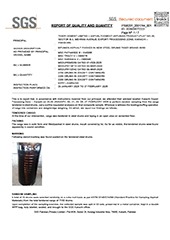
SGS Inspection Report Grade 35/50 Loading the Month of Jan-Feb 2026
Tiger Bitumen Price List
English Version
French Version